




Roll On With These 5 Tire Pressure FAQs

Of all the maintenance tasks a driver must deal with, filling your tires with air is one of the simplest. It doesn’t require any special training and can be completed at almost any gas station. Better yet, all modern vehicles come with an integrated tire pressure monitoring system (TPMS), which will alert you when your tires fall below a certain threshold. While you will have to search for “tire service near me” to take care of rotating, balancing, and patching tires, tire pressure is something you can take care of all by yourself––although the service team here at Faricy Chrysler Jeep will certainly be happy to lend a hand.
As a tire service center, there are a few questions around tire pressure that we see crop up time and time again that we want to answer. For example, tire pressure doesn’t need to be exact, but keeping it within the recommended level for your specific vehicle can go a long way in improving performance, safety, comfort, and fuel economy. From proper pressure ranges and fill-up frequency to ride quality and performance in extreme temperatures, we’ve gathered some of the most commonly asked questions related to tire pressure in this handy guide.
#1 – How Do I Know How Much Air to Put In My Tires?
Let’s start off with one of the biggest misconceptions surrounding tire pressure. While many drivers believe that the “max psi” stamped onto the side of each tire is the recommended tire pressure, that’s not actually the case. Max psi is––as you may have guessed––the maximum pressure that the tire is designed to withstand, and more often than not, a particular vehicle’s recommended tire pressure will be much lower than that max psi. For example, a tire might be labeled for over 50 psi, but the vehicle it is mounted on will likely only call for inflating it to 35 psi. This recommended psi takes into account a number of factors like the car’s overall weight and whether it’s designed with two-wheel drive or four-wheel drive.
Where is a driver to find a vehicle’s recommended psi? There are usually two places: the door jamb by the driver’s seat and the owner’s manual. The owner’s manual is well-known as a handy reference guide that covers virtually everything you need to know about a vehicle’s operation and capabilities, but the door jamb sticker doesn’t always get the same amount of attention. Open your driver-side door, and you’ll notice a rectangular sticker affixed to the vehicle. This sticker, often labeled “tire and loading information,” briefly covers a vehicle’s passenger and weight capacity and also includes information on the recommended tire size and pressure for the front and rear tires.
#2 – How Often Should I Inflate My Tires?
As far as checking your tire’s psi is concerned, the general rule of thumb is once a month. This schedule can be accelerated a bit in the colder months as low temperatures cause tires to lose pressure at a faster rate, but for most drivers, once a month is fine. That said, there are a few factors that can cause tires to deflate at an accelerated rate. Depending on your tire size, driving style, and vehicle’s overall weight, you might consider upping the schedule to once every couple of weeks or even every time you fill the gas tank if you’re particularly concerned about proper pressure.
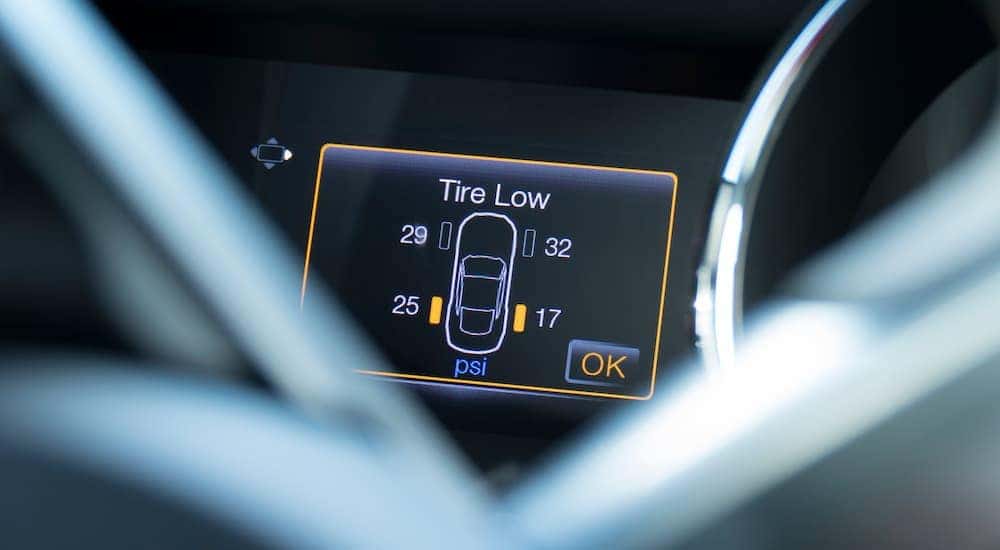
Of course, manually checking tire pressure isn’t necessary for vehicles with a TPMS that displays exact tire pressure, but it’s still a good idea to do a manual check every couple of months to ensure the system is well calibrated. TPMS technology has been required on all new vehicles since late 2007, but different makes and models vary in terms of how much information they’ll give you. All TPMS-enabled vehicles will alert the driver when tire pressure falls below a certain threshold, but on some higher-end models, you might even be able to see each tire’s current pressure in real-time.
As far as checking tire pressure is concerned, the most accurate readings come from a tire that’s had time to cool down after driving. As you roll down the road, the rubber compounds in a tire begin to heat up, which could throw off any pressure readings you take, especially after traveling at highway speeds. If you don’t feel like hanging out in the gas station parking lot until your tires cool down, invest in a tire pressure gauge. Costing all of a couple of dollars, these will allow you to test a tire’s pressure in the comfort of your own driveway, though adding any pressure will require the purchase of an air compressor.
#3 – Does Temperature Affect Tire Pressure?
As we mentioned above, cold weather will have a detrimental effect on tire pressure, with low temperatures causing a tire’s psi to drop more quickly than normal. This is due to the quirks of thermal expansion and contraction, which say that matter expands as it heats up and contracts as it cools down. An average tire will lose between one and three psi a month due to regular operation, but thanks to thermal contraction, this will be exacerbated in cold weather.
A tire can lose one or two psi for every 10 degrees the thermometer drops. To counteract this, make sure to check tire pressure more often when the temperature starts falling. The tires will regain some pressure as they get to cruising speed and start to heat up, but it’s a bit of an artificial bump as the pressure will drop again once the tires have a chance to cool down. If your TPMS light is on when you first start your vehicle but turns off after a couple miles of driving, it’s likely due to shifting temperature.
As you might expect, thermal expansion dictates that warm weather has the opposite effect, with a tire actually gaining one or two psi for every 10 degrees in temperature rise. This is an important consideration when it comes to driving your vehicle during the height of the summer, where overinflated tires can run the risk of a blowout, especially at higher speeds. For this reason, it’s a good idea to check your tire pressure regularly as things heat up during the summer months, especially if you’re going to be doing a lot of high-speed driving or carrying heavy loads.
#4 – How Long Can I Drive on a Tire With Low Pressure?
Low tire pressure should be addressed as soon as possible, especially if it falls below the 20 psi mark. Since tires on the road today are generally designed to operate at around 30 to 35 psi, anything below 20 psi can essentially be considered a flat tire. Driving with such low pressure dramatically increases the risk of a major tire failure, which should be avoided at all costs. It could result in a devastating blowout which, beyond totaling your tire, will also necessitate a full wheel replacement in most cases and can even damage your car.
That said, it’s not always easy to find a roadside air pump or handy tire service when you need it, so worst-case scenario, what’s the longest you can drive on an underinflated tire? It all depends on the weather, road surface, and driving speed. On a well-paved road at lower speeds, you should have time to reach your destination before addressing the issue. However, this decreases exponentially with higher temperatures, rougher surfaces, and higher speeds. If you are on the highway and get a low tire pressure warning, reduce speed as much as possible and pull off as soon as you see a place to inflate your tires.
#5 – How Does Tire Pressure Affect Ride Quality?
Whether it’s too low or too high, tire pressure will have a noticeable effect on ride quality. Overinflated tires reduce handling and lead to a bumpier, less comfortable ride. On the other hand, underinflated tires are more susceptible to blowouts due to overheating and can increase the chance of damage to the wheels. Gas mileage also suffers when tires don’t have the proper pressure, increasing a vehicle’s rolling resistance and forcing the engine to work harder to achieve the same results. For every one psi that your tires are underinflated, your fuel economy will drop by 0.4 percent. Lastly, driving with underinflated or overinflated tires can lead to uneven wear, reducing a tire’s tread life and taking money out of your pocket.
With over 11,000 tire-related crashes occurring each year, maintaining proper tire pressure is one of the easiest ways to improve your safety behind the wheel. It’s one of the first tasks that’s often taught to new drivers, and for good reason. Proper tire pressure will save you money by improving fuel economy and extending tread life. It’ll also make for a better driving experience overall, allowing your vehicle to perform as the designers intended. Today’s TPMS features have made keeping track of your tire pressure easier than ever, leaving little excuse for rolling around on overinflated or underinflated treads. If your vehicle dates from before the TPMS days, a cheap tire pressure gauge is well worth the investment in terms of safety, performance, and fuel economy. Follow the tips we covered above, and with any luck, you’ll never have another stranger at the gas station pipe up with a judgemental “you’re looking a little low there.”
0 comment(s) so far on Roll On With These 5 Tire Pressure FAQs