




Off-Road Evolution: The Jeep Wrangler By Generation
The automotive world hasn’t been the same ever since the first Willys-Overland Jeep CJ hit the market back in 1943. Widely considered to be the first mass-produced 4×4 vehicle for civilian use, the CJ essentially created the modern sport utility vehicle as we know it. While the CJ might have long since receded into history’s rearview mirror, the spirit of the original SUV lives on in every used Jeep Wrangler for sale here at your local Colorado Springs dealership.
Launched in 1987, the Wrangler built on the CJ’s off-road legacy while introducing some crucial new comfort, convenience, and safety features into the mix. The Wrangler has been wildly successful in that mission and has earned a loyal following amongst drivers who crave adventure, freedom, and off-road capability all wrapped up in one head-turning package. Famous for its removable doors and roof, the Wrangler has found a lot of success in traversing the road less traveled, both literally and figuratively.
The Wrangler has certainly changed over the years, steadily evolving to meet the changing needs of drivers without losing any of the athletic appeal that’s long drawn buyers to the unmistakable model. Let’s learn how the Wrangler has changed over the last few generations as we track the transformation of the iconic SUV.
First-Gen Wrangler YJ (1987 – 1995)
We won’t spend much time on the first-gen Wrangler, but a quick survey of the original YJ model is helpful when it comes to tracking the SUV’s evolution. While the original Wrangler—dubbed the YJ in Jeep-speak—adopted the same solid axle/open top formula as the CJ, it differed in some important ways.
Introduced in 1987, the YJ was designed with a wider track and upgraded suspension compared to its predecessor. Although it employed a similar leaf spring suspension, Jeep made some important upgrades in the form of larger springs, anti-roll bars, and trackbar suspension links that made the Wrangler much safer and more comfortable to drive on the highway.
However, the first Wrangler retained the CJ-7’s part-time 4×4 system, brawny front and rear axles, and open body design, and soon became an off-road icon in its own right. The best way to identify a YJ is its unique square headlights.
Second-Gen Wrangler TJ (1997 – 2006)
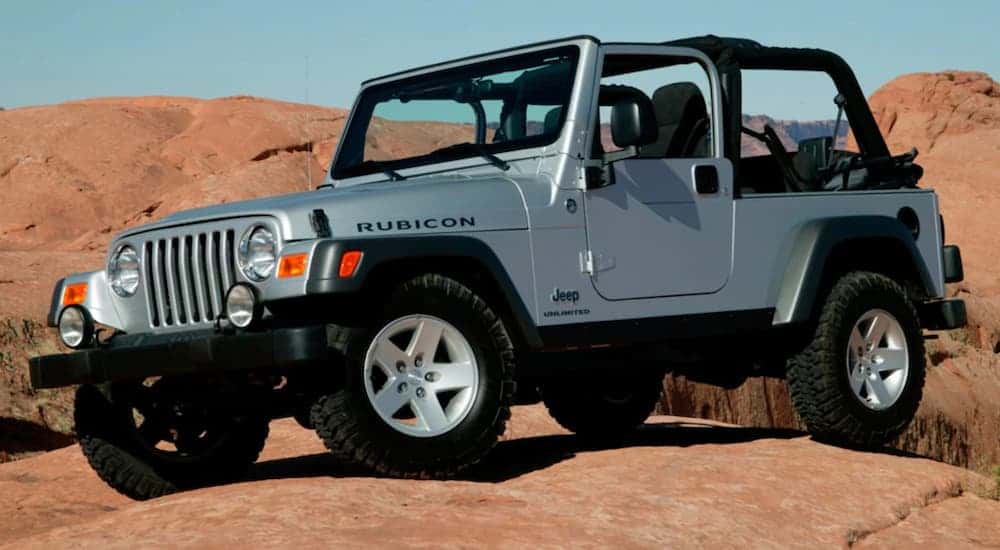
The second-gen Wrangler sought to differentiate itself from its predecessor with a new set of round headlamps inspired by the original CJ model. It might seem like a small detail, but it helped the Wrangler to recapture some of that original Willys magic. An even more important upgrade entered the fray in 2004 when Jeep introduced the Wrangler’s first long-wheelbase Unlimited model.
By stretching the SUV’s wheelbase by 10 inches, Jeep was able to improve passenger comfort, cargo space, and even the Wrangler’s towing capacity. While the standard model was limited to 2,000 lbs of towing power, the new Unlimited upped that figure to 3,500 lbs to make the model a more practical option for drivers who expect their SUV to pull its weight. The design also improved access to the rear seats, which is an important ergonomic consideration in the historically cozy Wrangler. However, it still only had two doors.
The TJ Wrangler was powered by a 4.0L I-6, which could also be found under the hood of the lighter-duty Cherokee and Grand Cherokee models. A 2.5L I-4 was also available as an entry-level option, though it was replaced by a 2.4L Chrysler engine cribbed from the PT Cruiser in 2003.
Jeep’s first Rubicon variant also entered the fray in 2003. While every Wrangler offers some level of off-road ability, the Rubicon quickly became the go-to choice for adventure-seeking motorists thanks to its robust roster of heavy-duty equipment. Named after California’s famed Rubicon Trail, the new trim added front and rear Dana 44 axles with locking differentials, a 4:1 Rock-Trac transfer case, 31-inch mud tires, rocker guards, and more.
One of the Wrangler TJ’s most important improvements was actually hidden under the chassis as a new coil-spring suspension replaced the leaf-spring design found on the original. While leaf springs are lauded for their simplicity and durability, coil springs are the obvious choice if you’re looking to spend a lot of your time away navigating unpaved roads and rough conditions, thanks to their improved articulation, comfort, and handling.
Third-Gen Wrangler JK (2007 – 2017)
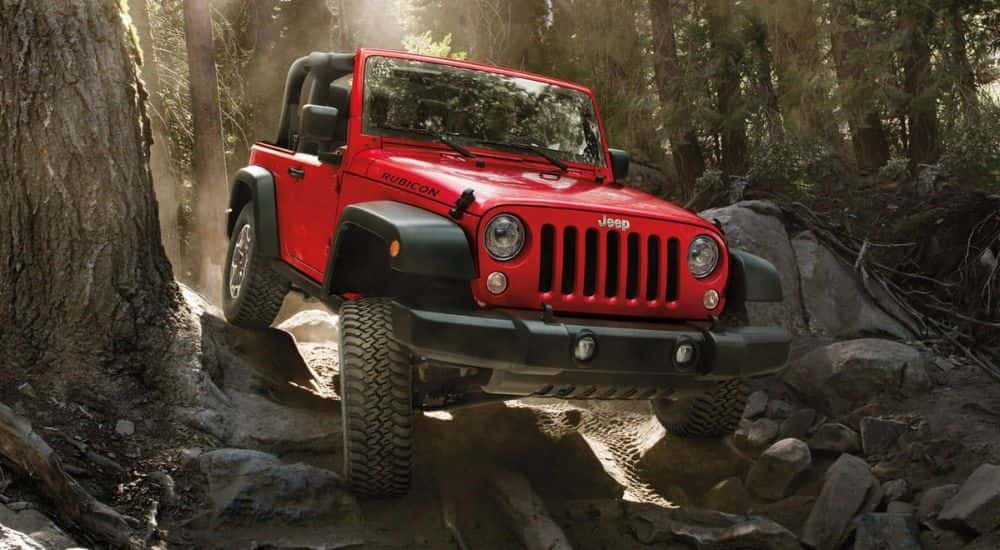
The Wrangler really hit its stride with the debut of the third-gen JK model. A top-down redesign included an entirely new frame, body, and suspension, reimagining the famous Jeep for the modern era. The JK focused on making the Wrangler a more accessible option for a new generation of drivers.
While it might have carved out a reputation as a go-anywhere adventure rig, Jeep knew that it needed to broaden the SUV’s appeal if it wanted to gain some market share. Basic comfort and convenience tech had never been the Wrangler’s strong suit, but as more drivers gravitated towards the SUV segment thanks to the popularity of new crossover options, Jeep saw a unique opportunity for growth.
The new Wrangler didn’t lose any of its off-road ability, but the third-gen model did see Jeep make a concerted effort to improve the SUV’s appeal from a comfort and convenience perspective. The automaker had long embraced a somewhat spartan approach that eschewed modern amenities, but the JK addressed this with remote power door locks, power windows, remote keyless entry, GPS navigation, and other convenience tech.
Jeep also improved on the long-wheelbase Unlimited model, stretching it even further and swapping out the two-door format for a new four-door design that made the Wrangler a much more enticing option for those seeking a convenient family vehicle. The strategy worked wonders, with the Unlimited quickly becoming the go-to choice for Jeep drivers. In fact, by 2017, three-quarters of all Wrangler sales could be credited to the four-door model.
On the mechanical side, the Wrangler gained stability control and anti-lock brakes as part of the standard package, as well as an optional limited-slip differential that’s perfect for maximizing traction in slippery off-road environs. But if there’s one upgrade that really encapsulates the wider trend towards practicality, it would have to be the new electronic disconnecting sway bar.
A sway bar goes a long way towards reducing body roll, improving stability and overall comfort. However, it can prove to be a limiting factor when venturing into off-road terrain. The Wrangler JK saw Jeep address this issue with an electronic disconnecting sway bar that allows the SUV to quickly shift between roles, maintaining stability and comfort for daily driving while enjoying maximum articulation and traction in serious off-road scenarios. Jeep also addressed the Wrangler’s fuel economy in the later JK years, replacing the original 3.8L V6 with a new 3.6L V6 that upped the efficiency while increasing power.
Fourth-Gen Wrangler JL (2018 – Present)
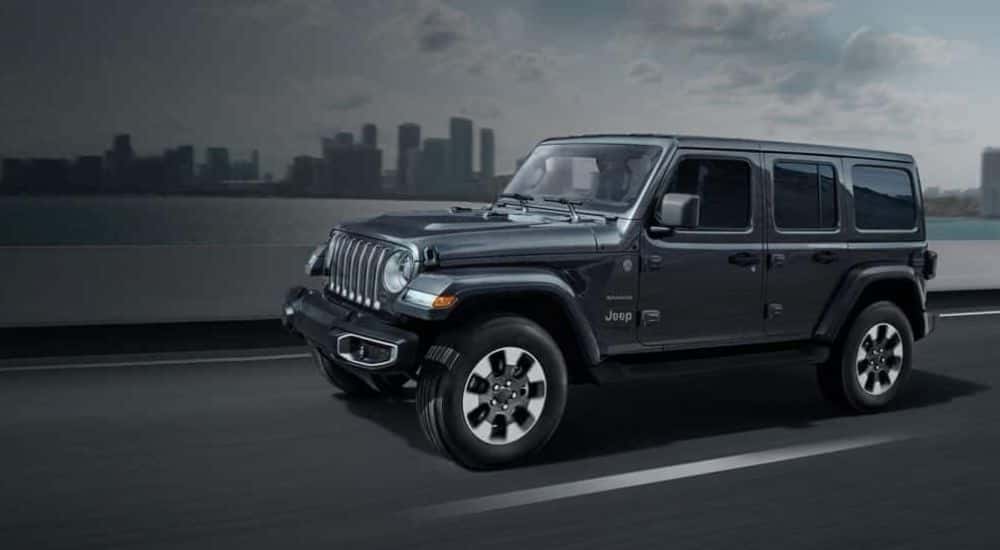
That brings us to the current mode. Hitting the market in 2018, the fourth generation welcomed the Wrangler into the modern era with a full complement of contemporary comfort, convenience, and infotainment tech. The bare-bones Wrangler of old will seem like a distant memory when you step inside a new fourth-generation model, especially when you catch a glimpse of the 12.3-inch touchscreen infotainment display, upgraded driver information display, and automatic climate control system.
Jeep has also managed to produce the safest Wrangler on record, with the Wrangler adding blind-spot monitoring, rear-cross-traffic alert, rear parking sensors, adaptive cruise control, and other key advanced driver-assistance systems (ADAS), making it more comfortable for city life around Colorado Springs.
The Wrangler is more versatile than ever in its newest iteration, providing buyers with three distinct 4×4 systems to choose from:
- Command-Trac represents the standard option and provides a well-rounded experience with a part-time 4×4 system that can split the engine’s torque equally between the front and rear axles.
- Selec-Trac opts for a full-time design that automatically adjusts to changing road conditions, making it perfect for everyday driving and light off-road use.
- Rock-Trac is here to tackle the toughest terrain Mother Nature has to offer. Limited to the Wrangler Rubicon, this 4×4 system has a 4:1 low-range gear ratio and electronic locking differentials that allow the SUV to power through loose terrain and steep rock faces.
The JL is equipped with a standard 3.6L V6 paired with a new-and-improved eight-speed transmission, although an available six-speed manual offers drivers a little more control behind the wheel. The base engine can now tow up to 5,000 lbs, though that figure drops to 3,500 lbs when discussing pre-2024 models.
The 2020 model year was marked by the addition of an available 3.0L turbo-diesel V6, which is a model of efficiency, getting 29 MPG on the highway, although this engine left the lineup by 2024. An available 2.0L turbocharged I-4 represents the most efficient post-diesel option, with an EPA-estimated 23 MPG on the highway for the 2024 model.
Jeep’s eTorque mild-hybrid upgrade for the V6 entered the fray in 2021 to provide drivers with a compelling combination of power and efficiency. But while it had the ability to produce 285 hp and 21 MPG combined, the mild-hybrid didn’t do enough to differentiate itself from the standard 3.6L V6 and was gone by the time 2024 rolled around.
There are also a few premium trims and alternative fuel options that deserve a brief mention as we discuss the fourth-gen Wrangler. Introduced in 2021, the Wrangler 4xe saw the SUV go partially electric with a new plug-in hybrid (PHEV) powertrain that offers the same legendary off-road ability in a more eco-friendly package. The 4xe can easily best the gas-powered model with 375 hp and 470 lb-ft of torque, but also offers an impressive 49 MPGe and 22 miles of all-electric range.
Then there’s the Rubicon 392. If you thought the Wrangler’s top off-road trim was impressive, just imagine how much fun it can provide with a 392 cubic-inch (6.4L) HEMI V8 engine under the hood. Rated for a nice, even 470 hp and 470 lb-ft of torque, the Rubicon 392 can sprint from zero to 60 mph in 4.5 seconds while boasting a two-inch suspension lift, Fox shock absorbers, 35-inch tires on bead-lock capable wheels, and all of the other sturdy gear you’ll need to become the king of the local trails around Colorado Springs.
Wrangle a Used Jeep at Faricy Chrysler Jeep
What does the future hold for Jeep’s off-road all-star? Only time will tell, but it’s safe to assume that the SUV will continue to integrate new comfort, convenience, and safety features while steadily adopting new off-road tech and other components that allow drivers to make some unforgettable automotive memories. No matter what the next generation might bring, it’s hard to imagine the Jeep Wrangler losing its status as one of the market’s most rugged, trail-ready options—even when you buy a pre-owned model.
0 comment(s) so far on Off-Road Evolution: The Jeep Wrangler By Generation