Faricy Chrysler Jeep
When a lot of people hear the phrase “routine maintenance,” they tend to only think about things like getting an oil change and checking the pressure in their tires. While those are both very important, there are other aspects of proper maintenance that are also vital to keeping you safely on the road. Proper brake service is necessary to make sure your brakes are in working order and will let you maintain control over your vehicle at all times.
Few parts of your vehicle are as important as the brakes – they are, after all, the only thing that lets you actively counteract the momentum of your vehicle once it is in motion. If you have ever had your brakes stop working, then we do not need to tell you how frightening that can be – and if you have never had it happen, then we strongly suggest you take our word for it. Here at Faricy Chrysler Jeep, we want to make sure all of our customers are happy, and that means making sure you are safe when on the road. Our service center is open six days a week to provide you with routine maintenance, including brake service, which keeps you and your vehicle safe and secure.
How much thought do you give to how your brakes work? Unless you're a mechanic, car enthusiast, or someone who appreciates random facts, you may not spend much time researching your brakes or how the system works. Fortunately, with Faricy Chrysler Jeep, you don't have to because we're here to break it down.
Most modern vehicles rely on hydraulic brakes, which means they use brake fluid. How that fluid responds when you engage the brake pedal is determined by the type of brake: disc or drum. Drum brakes are less common today because their design makes them prone to rust, corrosion, and overheating. Additionally, disc brakes are more efficient and offer greater stopping power.
Even so, some models still have drum brakes on the rear wheels. In this case, the hydraulic pressure from the brake fluid engages internal brake shoes, forcing the shoes outward so they press against the rotating drum within the wheel. As a result, the brake shoes create enough friction on the drum to slow down the vehicle.
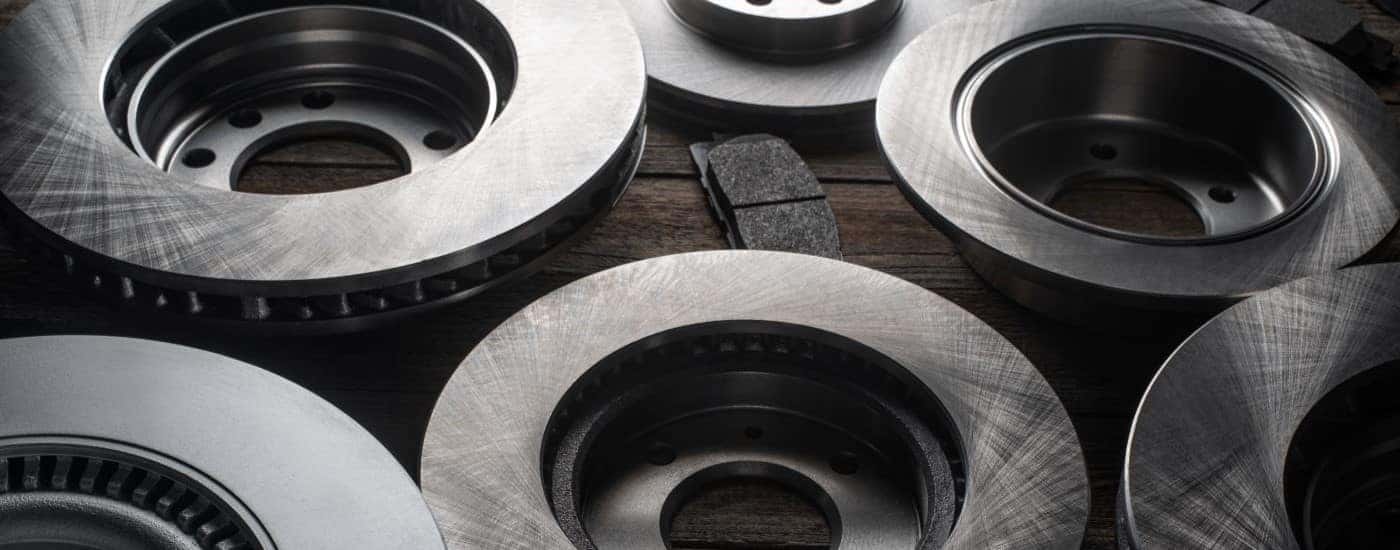
Your vehicle likely has disc brakes, which rely on brake pads and rotors rather than brake shoes and drums. By depressing the brake pedal, the master cylinder sends brake fluid down the brake lines to the calipers. The pistons in the calipers engage the brake pads, which squeeze against the rotors at each wheel to create the necessary friction to slow your vehicle's momentum.
The development of hybrid and electric vehicles introduced us to a new type of brake system known as regenerative braking. These systems are remarkable because they improve a vehicle's efficiency. Traditional hydraulic brakes waste a lot of energy when they work, converting the car's momentum into waste heat. Regenerative brakes use the vehicle’s electric motors to capture that energy as you brake and send it back to the battery the electric motor relies on for power. Hybrid and electric vehicles still have hydraulic brakes that will activate when you press hard on the brake pedal in an emergency, but drivers can reap the benefits of extending their vehicle's range by using regenerative braking instead during normal driving.
The final type of braking system is the emergency brake, which bypasses the main hydraulic brake system. Emergency brakes, also commonly known as parking brakes, were initially designed as a safeguard if a vehicle's standard braking system failed. However, they are also used to keep your car from rolling away when parked.
On older models, the emergency brakes will be a mechanical system controlled by a center lever or a pedal. Activating the system pulls on cables running to your rear brakes, holding the car in place. Because this is a mechanical system, it relies on your arm or leg strength to stop the vehicle in an emergency without any hydraulic boost. Most modern cars instead have an electronic system with small electrically-driven calipers to brake the rear wheels. This has the added advantage that it can be programmed to activate automatically whenever the car is put into park.

A lot of people only think about reactive maintenance: taking care of things when they no longer work properly. For example, you probably do not replace your windshield wipers until they start to leave too much water or streaks that impede visibility on your windshield. However, when it comes to brake service, you need to consider proactive maintenance. Do not wait for your brakes to stop working to have them properly taken care of.
When you come in for brake service, our expert service professionals will check the fluid and condition of your brakes and their components. You can also have your brakes inspected and maintained while you are here for other basic maintenance, such as when you are getting an oil change or alignment adjustment. If you are unsure how often you should come in for this kind of routine maintenance, then check your vehicle’s owner’s manual for the manufacturer’s recommended service intervals.
Keep in mind that the brake pads and rotors on your vehicle will wear down normally over time. You also need to have the fluid changed as a regular part of maintenance, not due to any mechanical failure or issue––it is just a part of owning a vehicle. Your brakes put in a lot of work while you are driving, especially if you spend a lot of time in stop-and-go traffic or driving through the mountains around Colorado Springs, and all that work wears them down. Having your brakes inspected regularly, and maintained as needed, will keep your vehicle running smoothly and keep you safer on the road.
While most drivers think of a vehicle's engine as one big unit, it relies on many moving parts. The same is true for your brakes, with the brake rotors and pads being two of the most critical components. But what makes them so crucial to your vehicle's stopping power?
When you depress the brake pedal, the master cylinder sends brake fluid through the brake lines to the calipers. Once the fluid reaches the calipers, pistons force your brake pads to put pressure on the rotors located at each wheel. The pressure generates friction, which slows the vehicle by converting momentum to heat. By taking your foot off the brake pedal, you reverse the process, releasing the brake pads from the rotors.
Now, consider this entire process occurring every time you engage the brakes, whether stopping at a red light or using the brake to adjust your cruising speed. Each time you press the brake pedal, your brake pads are worn away, and your rotors soak up intense heat. Even casual driving will eventually wear down your pads and rotors, with more aggressive driving styles and stop-and-go traffic heightening that wear.
When you bring your car, truck, or SUV in for brake service, you may discover it's time to replace the brake pads. Brake pads commonly last between 30,000 and 60,000 miles, depending on your driving style. That large spread means it is important to have your brake pads checked regularly in order to replace them before they wear out completely. While rotors generally last longer than brake pads, it is often a good idea to replace everything at the same time.
Replacing the brake pads and rotors together extends the life of your brake system. In some cases, drivers may have their rotors resurfaced, but this isn't ideal. Although resurfacing is cheaper than buying new rotors, modern rotors are not designed to be resurfaced, and there is often not much material left after shaving them down. Our technicians prioritize your safety and always recommend doing the job right the first time to help you protect and get the most out of your investment.
Coming in for routine brake service based on your vehicle's manufacturer’s recommendations is a great way to stay safe on the road. However, it is also important to be aware of how your vehicle handles and pay attention to anything that may be a warning sign of a serious issue. Even a minor issue with your brakes can be dangerous––they are what lets you stop when you need to, after all. Something minor can become a much larger and more dangerous problem if you do not have it dealt with right away. Warnings signs that you need to have your brakes serviced or inspected include:
If you notice any of these warning signs, then do not hesitate to bring your vehicle to Faricy Chrysler Jeep for a brake service. Strange sounds and unusual vibrations can mean minor problems that are easy to fix––as long as you catch them right away. Waiting can make things much worse, and worn brake pads or discs can seriously reduce your ability to control your vehicle.
We understand that bringing your vehicle in for brake service can be inconvenient, leaving you to rearrange your schedule, miss important appointments, or juggle school pickup with someone else. It's a headache that we promise to remedy by helping you make the most out of your service experience. When you trust The Faicy Boys with your vehicle, you're trusting a team that knows the value of your time.
As we assess the brakes on your vehicle and diagnose any brake-related issues, we'll also conduct a multi-point inspection that gives you insights into other maintenance needs and your vehicle's overall health. For example, we'll inspect the tires, steering components, and fluid levels. After we've reviewed your vehicle, we'll report any areas that need immediate repair. This can help you catch any developing issues and get everything done at once.
Let's say it's time to replace your SUV's brake pads and rotors. You've already brought your vehicle in for service, but you also know it's time for a routine oil change, filter change, and tire rotation. Our technicians also found that a tire alignment would remedy a few performance issues and help extend the life of your tires. It only makes sense to complete these services at the same time to minimize your inconvenience and save you valuable time.
Here at Faricy Chrysler Jeep, we pride ourselves on the skills and quality of our certified technicians and service professionals. We know that a lot of automotive maintenance can be done by skilled people at home––things like oil changes, checking tire pressure, and refilling tires with air. Even some engine maintenance can be handled by skilled vehicle owners. When it comes to brake service, however, we strongly recommend that all of our customers come in for professional assistance with their vehicles.
The brakes on your car, truck, or SUV are vital for maintaining proper control while on the road––or off-road, for that matter, if you drive a Jeep. Brake service is too important to risk making a mistake on, and the consequences of failed brakes can be disastrous, even deadly. At Faricy Chrysler Jeep, we stand behind our certified service professionals and know they will take the greatest care when inspecting or making repairs on your vehicle.
Our state-of-the-art service department is only as good as our technicians because we wouldn't have a service center without them. With Faricy Chrysler Jeep, you're putting your car, truck, or SUV in trusted hands and can rest easy knowing that our technicians will treat your vehicle like their own. This level of service is unheard of, and so is our expertise.
We believe in reinvesting in our team and helping our technicians fulfill their professional and personal dreams. For some, this looks like expanding their knowledge as diesel mechanics; for others, it's learning more about trim work or collision repair. This ongoing pursuit of knowledge is integral to everyone on our team and showcases why we have one of the best and most talented teams in the Colorado Springs area. Our technicians never settle for the status quo. Instead, they're constantly expanding their skills to serve customers like you better.
Because of this, our technicians can handle every make and model. So whether you drive a Honda Pilot, a Chevy Suburban, a Ford F-150, or a Jeep Wrangler, your vehicle has a place in our service center. Moreover, you can rest assured that trusting Faricy Chrysler Jeep gives you a front-row seat to our expertise and an automotive partner for life.
We are located in northeastern Colorado Springs, at 4950 New Car Drive, just off East Woodmen Road. If you live here in Colorado Springs, you can get to us easily by taking Highway 21 or Interstate 25 to East Woodmen Road. From Highway 21, head west to New Car Drive, and from Interstate 25, head east to New Car Drive just past the large intersection with Austin Bluffs Parkway.
Our customers coming up from Pueblo usually take Interstate 25 North, using the East Woodmen Road exit and heading east to New Car Drive. For our customers coming down from Denver or Boulder, you can use Interstate 25 South or take Highway 83 down until it meets with Highway 21. Just take the East Woodmen Road exit and head east from Interstate 25 or west from Highway 21 until you get to New Car Drive. No matter which route you take to get here, Faricy Chrysler Jeep is ready to help with all your maintenance needs.

At Faricy Chrysler Jeep, you are our priority. Every decision we make in running our dealership, hiring our staff, and providing policies for employees to follow is meant to ensure you receive the very best experience possible. Whether you are interested in buying a new or used vehicle or need to come in for brake service or other maintenance, we are here to help. Founded in 1942, we have over 80 years of experience in the auto industry, which is why we focus so much on being a positive and engaged part of the community here in Colorado Springs. Visit us today, and let us make car ownership easy!